Conference Poster Elevator Pitch: How to Explain Your Work Fast
In This Article
Why your conference poster elevator pitch matters
Your conference poster elevator pitch is the short, clear explanation you give when someone stops at your poster and asks, So, what is this about? That moment can feel oddly high pressure. You may have spent months on the work, but you often get less than a minute to make it understandable.
A good pitch is not a memorized speech that you fire at every visitor. It is a compact starting point for a conversation. It gives people enough context to decide what they want to ask next. It also helps you sound calm, even when the poster hall is noisy and your coffee has worn off.
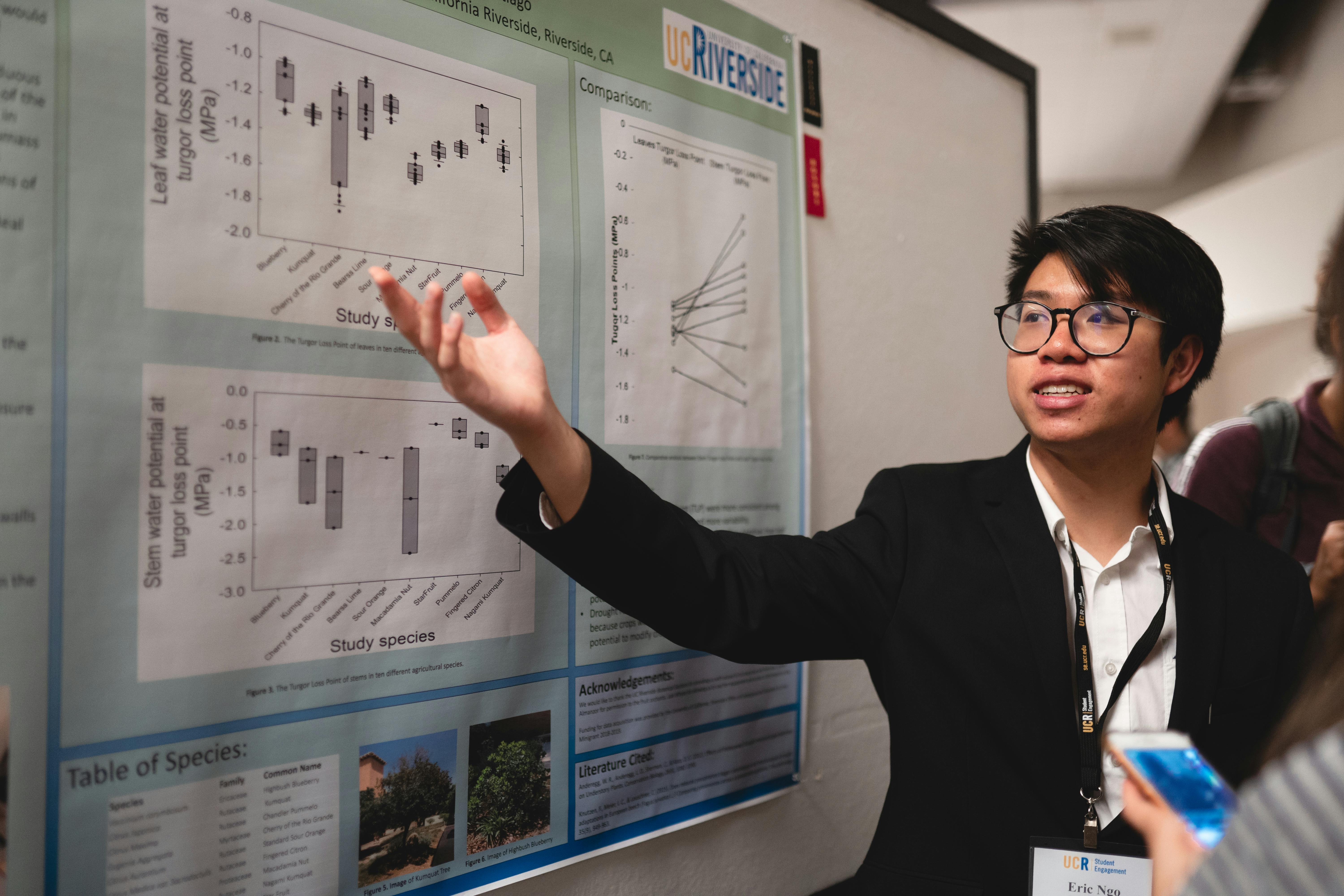
For graduate students and early-career researchers, this skill is worth practicing. Poster sessions can lead to collaborations, job leads, methods advice, publication ideas, and useful critique. More often, they help people remember you as someone who can explain complex work with care.
Your poster design matters too. A cluttered poster makes your pitch harder because you must explain around the design. A clear visual hierarchy lets you point, summarize, and move quickly. If your layout needs work, you can create with Graffiy and build cleaner scientific visuals before you write the pitch.
Start with the visitor, not the poster
Most presenters build their pitch from left to right across the poster. That seems logical, but it is usually too slow. Visitors do not need a tour of every panel. They need orientation, relevance, and a reason to keep listening.
Start by asking who the visitor is, even if you only infer it. A specialist wants the technical wrinkle. A nearby field researcher wants the problem and the method. A student may need definitions. A recruiter may care about skills, tools, and judgment.
You can use a simple opening question when appropriate: Are you familiar with this system? or Do you work on this pathway, or are you coming from a different area? This question buys you time and helps you choose the right version.
There is a reason this works. Clear communication depends on audience needs, not speaker preferences. The National Institutes of Health offers useful guidance on plain language and audience-centered writing through its plain language resources. The same principle applies in a poster hall.
If you are nervous, remember that tailoring does not mean dumbing down. It means respecting attention. You can still be rigorous while choosing the shortest useful path into your work.
Build your conference poster elevator pitch in five parts
The best conference poster elevator pitch has a simple internal structure. You can adapt the wording, but the logic stays the same. Think of it as a five-part arc: problem, gap, approach, finding, and why it matters.
- Problem: What broad issue does your project address?
- Gap: What is unknown, inefficient, debated, or missing?
- Approach: What did you do to investigate it?
- Finding: What is the most important result so far?
- Relevance: Why should this visitor care?
Here is the key: each part should be one sentence or less. If you cannot say the problem in one sentence, your poster probably needs a clearer title or takeaway. If you cannot state the finding simply, you may be mixing results with interpretation.
Try this template first:
We study [problem] because [gap]. In this project, we used [approach] to test [specific question]. The main result is [finding], which suggests [meaning or next step].
Now make it sound like you. A natural pitch beats a polished but robotic one. You are allowed to use first person. You are also allowed to say, Our preliminary result suggests, if the work is still developing.
For example, a neuroscience presenter might say: We study how sleep disruption affects memory because the mechanism is still unclear. In this project, we used calcium imaging to track hippocampal activity after fragmented sleep. We found that a specific activity pattern was reduced, which may help explain why memory consolidation fails under poor sleep conditions.
That version is short, but it gives the visitor handles. They can ask about imaging, sleep fragmentation, the activity pattern, or memory testing. That is the real goal.
Write three versions: 10 seconds, 30 seconds, and 60 seconds
You need more than one pitch because poster visitors behave differently. Some are rushing to a talk. Some want a deep technical exchange. Some stop because your figure caught their eye. A flexible conference poster elevator pitch lets you meet each person where they are.
The 10-second version is your doorway. It should work when someone glances at the poster and says, Can you give me the quick version? Keep it to one or two sentences.
We are testing whether a low-cost sensor can detect early water stress in greenhouse tomatoes. Our early results suggest it can flag stress before visible wilting appears.
The 30-second version is your standard pitch. It adds the gap and method, but it still avoids details that belong in the discussion.
We are testing whether a low-cost sensor can detect early water stress in greenhouse tomatoes because current monitoring tools are often expensive or too slow. We compared sensor readings with plant physiology measurements under controlled irrigation treatments. The sensor predicted stress before visible wilting, which could help growers intervene earlier.
The 60-second version is for interested visitors. It adds one important detail, one limitation, and an invitation.
We are testing whether a low-cost sensor can detect early water stress in greenhouse tomatoes because current monitoring tools are often expensive or too slow. We ran controlled irrigation treatments and compared sensor readings with stomatal conductance and leaf water potential. The sensor predicted stress before visible wilting, especially under moderate deficit conditions. We still need to validate it across cultivars, but the result suggests a practical screening tool. I would be curious whether you have seen similar early indicators in field settings.
Notice that the longer version does not become a methods lecture. It simply gives enough detail to support the claim. That restraint is hard, but it is what makes you sound confident.
Map your pitch to your poster layout
Your pitch should match the visual order of your poster, but it should not describe every element. Use your poster as a map, not a script. Point to only the figures that carry the story.
Before the conference, stand in front of your poster and identify three anchor points. Usually, these are the title, the central method figure, and the main result figure. If your poster has more than three essential points, it may be trying to do too much.
A strong pitch often follows this movement: title first, method visual second, result figure third. This gives the visitor a physical path. It also prevents you from staring at the floor or reciting from memory.
If your poster has a dense methods section, do not begin there unless the visitor asks. Most people need the reason before the protocol. Say the question first, then explain the method as the tool you used to answer it.
Use visual cues in your design to support the pitch. A bold takeaway sentence, numbered sections, and clear figure captions make your job easier. Your words and visuals should agree about what matters most.
Adapt your pitch for different conference visitors
Different visitors need different levels of detail. You do not need to create a separate talk for everyone, but you should prepare a few shifts in emphasis. This is where many early presenters improve quickly.
| Visitor type | What they likely need | How to adjust your pitch |
|---|---|---|
| Specialist | Technical novelty and evidence | Name the method, comparison, or mechanism sooner. |
| Adjacent researcher | Problem, context, and transferable idea | Reduce jargon and explain why the system matters. |
| Faculty member | Research judgment and next steps | Include the gap, limitation, and future experiment. |
| Industry visitor | Application, constraints, and scalability | Emphasize performance, cost, reliability, or workflow. |
| Student or general attendee | Plain explanation and one takeaway | Use an analogy, define terms, and keep it short. |
For a specialist, you can say: We used single-cell RNA sequencing to compare treated and untreated organoids, and the surprising result is a shift in the progenitor population. That visitor will likely ask about clusters, controls, or batch effects.
For a non-specialist, try: We are studying how this tissue changes after treatment at the level of individual cells. The main finding is that one cell group expands more than expected, which may explain the recovery pattern we see.
Both versions are accurate. One uses field-specific terms because they are useful. The other removes them because they slow understanding. Your job is not to impress every visitor with vocabulary. Your job is to make the work available.
Sound confident without overselling
Confidence in a poster pitch comes from clarity, not hype. You do not need to claim that your work solves the entire problem. In fact, careful limits often make you more credible.
Use precise verbs. Say suggests when the evidence is preliminary. Say shows when the result is directly supported. Say we are testing if the project is ongoing. These small choices signal that you understand your evidence.
Avoid apology openings. Do not begin with, This is probably confusing, or I am sorry, the poster is messy. If something is incomplete, frame it calmly: This is a preliminary dataset, so we are treating the result as a lead for the next experiment.
Also avoid overloading visitors with caveats before they understand the main finding. Lead with the story, then add limitations when relevant. A visitor cannot appreciate nuance if they do not yet know the point.
Practice out loud, but do not memorize every word. Memorized pitches often collapse when interrupted. Instead, memorize the five-part structure and a few exact phrases for difficult sections.
Use questions to turn the pitch into a conversation
A poster session is not a lecture series with worse lighting. It is a conversation space. Your pitch should end with an opening, not a full stop.
Good closing questions include: Does that connect with your work? Would you like the method details? Have you seen a different explanation for this pattern? These questions invite the visitor to shape the next part.
If the visitor asks a question you cannot answer, do not panic. Say, I do not know yet, but that is a useful point, then connect it to a next step. This response is far better than pretending certainty.
Keep a small notes section on your phone or in a notebook. After strong conversations, write down names, suggestions, and follow-up ideas. Poster sessions move quickly, and your memory will not catch everything.

Practice routine for the week before the conference
Practice should be short, specific, and slightly uncomfortable. Reading your pitch silently does not count. You need to hear where you ramble and where the logic breaks.
Three to five days before the conference, record your 30-second version on your phone. Listen once for clarity, then once for pace. If you sound rushed, cut words instead of speaking faster.
Next, practice with two people. Choose one person in your field and one outside it. Ask them to repeat your main point back to you. If they cannot, the pitch needs a clearer problem or finding.
Finally, rehearse interruptions. Have a friend stop you after 10 seconds with a technical question, then a basic question. Real poster sessions are messy. Practicing interruptions makes you more relaxed when they happen.
On the conference day, warm up with the shortest version. Say it once before the session starts. Then let the first few visitors help you settle into the room.
A simple script you can customize
Here is a practical conference poster elevator pitch script you can adapt before your next session:
Thanks for stopping by. We are studying [broad problem] because [specific gap]. For this project, we used [method or dataset] to ask whether [research question]. The main result is [key finding], which suggests [interpretation or practical implication]. The next step is [future work or limitation]. I can walk you through the main figure if you are interested.
Now trim it. Replace abstract nouns with concrete ones. Remove background that every visitor in your field already knows. Define only the terms that block understanding.
You can also prepare a one-sentence takeaway and place it on the poster. This helps visitors who arrive while you are speaking with someone else. It also keeps your own pitch anchored.
A strong takeaway might read: Early sensor changes predicted plant water stress before visible symptoms appeared. Another might read: Immune cell state, not total cell number, best explained treatment response in our model.
These sentences are not flashy. They are useful. That is the standard to aim for.
Final checklist before you present
- Can you explain the project in 10, 30, and 60 seconds?
- Does your first sentence include the problem, not just the technique?
- Can you point to the main result figure within the first minute?
- Do you have one version for specialists and one for non-specialists?
- Can you state one limitation without weakening the whole pitch?
- Do you end with a question or invitation?
Your conference poster elevator pitch will improve during the session. That is normal. Pay attention to where visitors lean in, where they look confused, and which questions repeat. Those signals tell you what to adjust.
The best poster presenters are not the ones who talk the longest. They are the ones who help visitors understand quickly, then make room for a useful exchange. If you can do that, your poster becomes more than a display. It becomes a doorway into your research community.
Frequently Asked Questions
How long should a conference poster elevator pitch be?
Prepare three versions: 10 seconds, 30 seconds, and 60 seconds. The 30-second version is usually the best default because it gives context, method, and a key result without trapping the visitor.
What should I do if a visitor interrupts my poster pitch?
Treat the interruption as a sign of interest, not a failure. Answer briefly, then either return to your main thread or ask whether they want more detail on that point.
How can I make my poster pitch less memorized?
Memorize the structure, not every sentence. Practice the problem, gap, approach, finding, and relevance in order, then allow the wording to change naturally with each visitor.
Written by
Shobajo AbdulAzeez
Tags
Share this article